

Novel Biomarker for Understanding MS Biology
BBB-ASL can provide a novel biomarker for MS because it quantifies a BBB property that conventional clinical MRI does not directly measure: the exchange of water across the BBB. Instead of relying on gadolinium leakage, BBB-ASL uses magnetically labeled arterial blood water as an endogenous tracer and models how efficiently labeled water moves from the microvasculature into tissue, typically summarized as the BBB water exchange rate (k_w) or related exchange-time (Tex) measures. This targets BBB function rather than overt breakdown, and it can be repeated frequently without contrast administration.
This distinction matters in MS because BBB dysfunction is not limited to the acute enhancing lesion stage. Subtle and spatially diffuse BBB alterations may persist in chronic lesions and extend into normal-appearing white matter, where standard contrast enhancement is often absent. In research settings, DCE-MRI can detect subtle permeability changes, but it still requires contrast and careful standardization. BBB-ASL offers a contrast-free way to probe BBB-related physiology in these “silent” compartments, potentially capturing disease biology beyond the short window of overt enhancement.
Early MS evidence supports its biomarker promise. A preliminary study reported abnormal BBB water exchange in chronic MS lesions, consistent with the concept that chronic tissue injury and microvascular dysfunction can leave a measurable BBB signature after acute inflammation has subsided. This creates an opportunity to use BBB-ASL as a quantitative readout of lesion stage and chronic activity, and to study how BBB function differs across lesion types and tissue compartments within the same individual.
As a biomarker, BBB-ASL could contribute in three practical ways. First, it enables non-contrast longitudinal monitoring, which is especially relevant in MS where repeated imaging is common and guidance increasingly emphasizes using gadolinium only when it adds clear clinical value. Second, it provides a mechanistically distinct signal that complements lesion burden and perfusion measures by focusing on exchange across the BBB rather than only blood flow or macroscopic leakage. Third, it may improve stratification by identifying patients or brain regions with persistent microvascular and BBB dysfunction that might relate to progression, symptom burden, or treatment response, even in the absence of enhancement.
Taken together, BBB-ASL has the potential to become a novel MS biomarker by offering a quantitative, repeatable, contrast-free assessment of BBB function that can be investigated across lesion stages and normal-appearing tissue. The key translational steps are demonstrating robustness across sites and sequences, and validating BBB-ASL metrics against clinical outcomes and established BBB measures such as DCE-MRI permeability indices in well-characterized MS cohorts.
Figure 1 exhibits a Fluid attenuated inversio recovery (FLAIR) image, cerebral blood flow (CBF) and time of exchange (Tex) maps of a healthy volunteer while Figure 2 shows a person with MS (pwMS). In the preleminary results, increased CBF values at the lesions than normal appearing white matter (NAWM) was observed in patients wtih MS. Overall, the Tex values of NAWM were lower than those of lesions in pwMS.
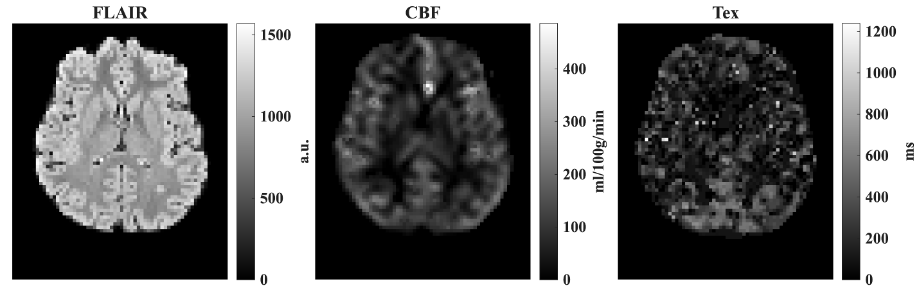
Figure 1 FLAIR, CBF and Tex maps of a volunteer
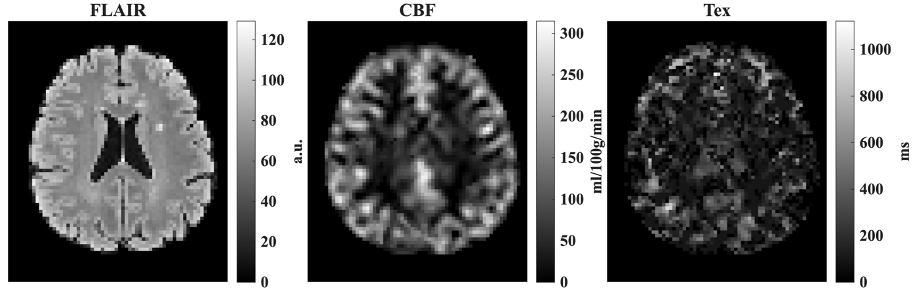
Figure 2 FLAIR, CBF and Tex maps of a person with MS.